Construction hoarding as a marketing asset: the math most developers miss
A typical Ottawa mid-rise build runs 18 to 36 months from fence-up to substantial completion. For that entire period, the construction hoarding sits in front of public traffic on a city street, at car-window and pedestrian-eye height. That is longer than most billboard contracts run.
Treated as compliance plywood, the hoarding is an eyesore that signals indifference to the neighbourhood. Treated as a sign, it is one of the cheapest customer-acquisition assets the project will ever own. The per-unit cost of customer reach is hard to beat. The hoarding has to go up regardless, so the incremental cost of wrapping it properly is small. The incremental output is not.
This is the case for treating construction hoarding as a marketing surface, the math behind it, what a properly designed multi-brand wrap actually looks like, and the practical specs that make the difference between a wrap that holds up for two years and one that does not.
The construction hoarding most developers settle for
Walk Preston Street, Bank Street, or rue de Hull on a given week and you can find both types in two blocks. The first type is bare 4'x8' plywood with a few weathered notices stapled to it, the occasional fly-poster, and the eventual graffiti. The second type is a fully wrapped surface carrying the project identity, the GC's mark, a leasing or pre-sales call to action, and the regulatory copy designed into the layout.
The difference between the two is small in cost. The hoarding lumber, the fasteners, the permit-required signage, and the labour to install the fence are identical. The wrap material and the design work are the variable cost. On a 200-foot hoarding run, the all-in cost of properly wrapping it is a small fraction of the rest of the project budget.
The difference between the two in what it produces is large. The first hoarding signals to the neighbourhood that the developer is treating the project as a logistics problem. The second signals that the project is being run carefully and that the eventual building will be too. Property managers and leasing agents reading the same hoarding draw the same conclusion. Prospective tenants do too.
The CPM math
Cost-per-thousand-impressions on outdoor billboards in mid-sized Canadian markets varies widely, but industry estimates run from low single digits to double-digit dollars per CPM depending on location, board size, and rotation. On-premise outdoor signage, including construction hoarding, sits dramatically lower on the CPM curve. Industry estimates put on-premise CPM in the range of roughly $0.02 to $0.15.
The reason the on-premise number is so much lower is structural. The hoarding lumber, the fasteners and the safety signage have to go up regardless of whether the developer treats the surface as marketing or as plywood. Wrap material amortized across an 18-to-36-month exposure period on a high-traffic street produces an impression count in the hundreds of thousands to low millions, depending on the street.
The Outdoor Advertising Association of America (OAAA) and the US Small Business Administration's Signage Sourcebook both treat on-premise signage as the most cost-effective form of out-of-home advertising available to small and mid-sized businesses. The CPM math is the reason. For a developer running an 18-to-36-month build cycle, the math applies even more strongly because the surface is essentially free at the margin.
Pre-leasing and pre-sales from the fence
Every email or call to a leasing or pre-sales contact that originates from the hoarding is a lead that did not require Google or Meta spend. Across an 18-to-36-month exposure window, the lead volume from a well-designed hoarding wrap can be material. The wrap also carries trust signals that paid digital does not: it shows a leasing agent, a property manager, a GC and a project owner all standing behind the same project on the same physical surface in the neighbourhood where the building will exist.
The mechanics:
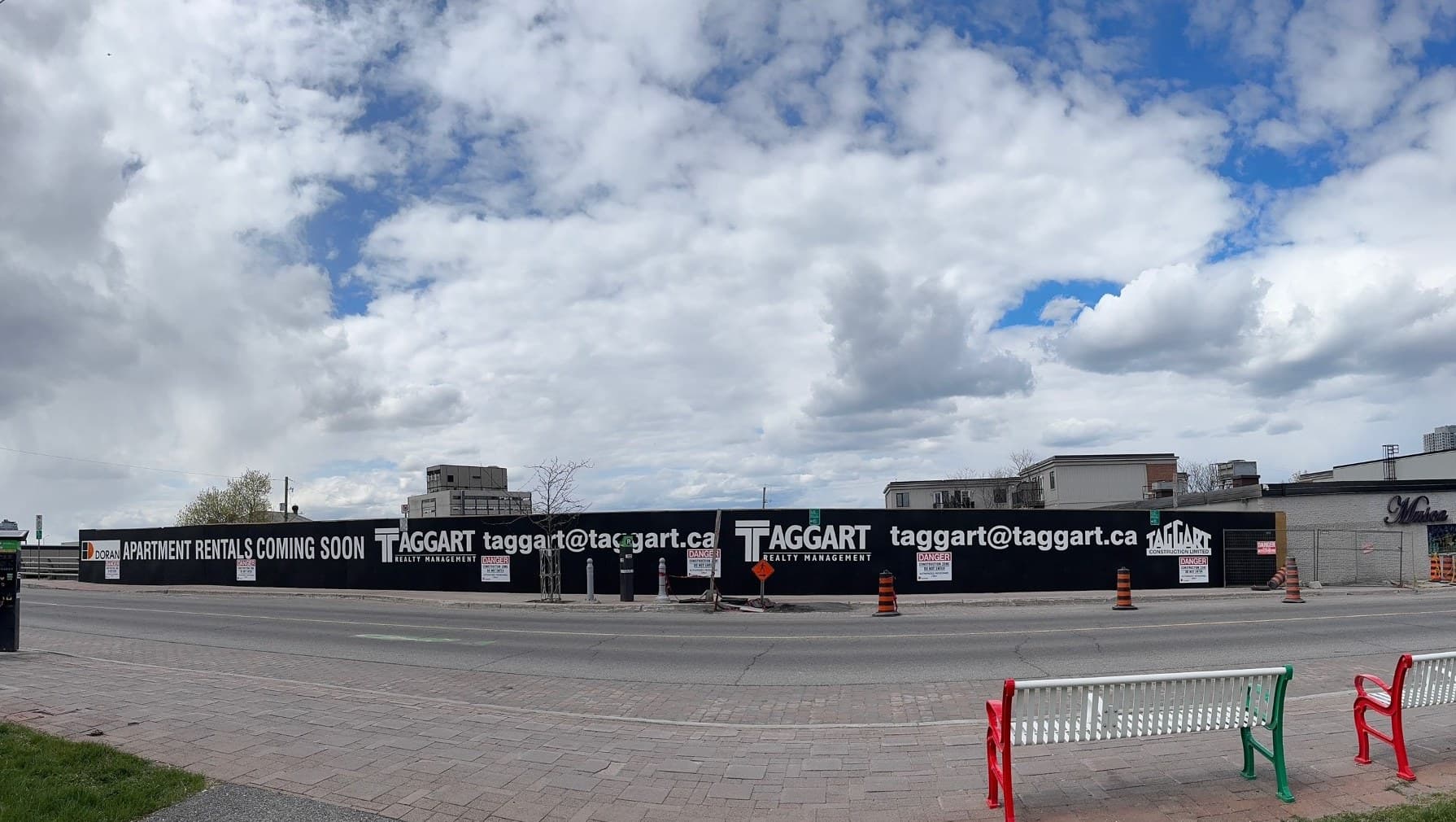
- A clear headline. "APARTMENT RENTALS COMING SOON," "COMMERCIAL SPACE FOR LEASE," "PRE-SALES NOW," set in clean white sans-serif caps that read from across a four-lane street. The headline is the single most important piece of copy on the wrap.
- A contact pathway. An email address, a phone number, or a QR code that resolves to a working leasing or pre-sales page. The contact pathway has to be checked by a real person during build hours.
- Repetition along the run. A single mark at the midpoint of a 200-foot hoarding is wasted real estate. The full message - identification, headline, contact - has to repeat at two or three intervals so that every passerby catches the complete pattern regardless of which direction they are walking.
USD 1997 and UC 2012 do not study construction hoarding specifically. They study primary and secondary on-premise signage at operating businesses. The findings translate cleanly to the hoarding case: each additional visible sign element produced measurable lift in their data, and signage that handled wayfinding and identification together outperformed signage that only handled one.
The multi-brand layout problem
Most developments involve more than one brand on the hoarding. The general contractor identifies itself. The property management or leasing arm carries the pre-leasing call to action. Sometimes a separate civil or site contractor identifies itself at the corner most visible to site traffic. Sometimes the development's brand is its own identity, separate from any of the three.
Coordinating those brands on one continuous 200-foot wall takes design discipline rather than just vinyl. Each brand needs a hierarchy of presence: which mark sits in the lead position, which sits in the secondary position, which mark handles the call to action, which mark handles the safety and compliance copy. Get the hierarchy right and the hoarding reads as a coordinated family of companies behind a single project. Get it wrong and it reads as competing logos.
The Taggart Group hoarding on Preston Street in Little Italy is a working example of the multi-brand pattern. Three Taggart-family brands - Doran Contractors handling general contracting, Taggart Realty Management overseeing leasing, and Taggart Construction Limited handling civil and site work - share the same 200-foot wrap. The repeating pattern along the Preston frontage runs the Doran "D" corporate mark, the APARTMENT RENTALS COMING SOON headline, and the Taggart Realty leasing email, then resets. At the corner where the hoarding turns the property, the Taggart Construction panel takes over the face most visible to incoming site traffic. The full case study is here: Taggart / Doran construction hoarding wrap, Preston Street Ottawa.
The repeating pattern is not aesthetic. It is the mechanism that makes the hoarding work for traffic flowing in both directions on a busy street. Nobody walks past without catching the complete message at least once.
Practical specs that hold up for two years
A construction hoarding is not a building sign. It is a temporary install that has to look permanent for one to three years, then come down without damaging the underlying fence. The specs that matter:
Backing layer. Coroplast and ACM are the two practical options. Coroplast is meaningfully cheaper. ACM holds up better to vandalism and survives the weather more reliably across an 18-to-36-month exposure. On a busy pedestrian street like Preston, where casual knife damage is a real risk, the case for ACM strengthens. On a quieter site or a shorter build cycle, coroplast is the right call. The Taggart Preston Street project used coroplast and absorbed the tradeoff: within weeks of installation, knife damage cut through several panels. That gap is worth talking through with the developer before the spec is locked.
Matte black sheeting under everything. A consistent matte-black background across the full run gives every brand mark and every line of type maximum contrast and legibility, regardless of the condition of the underlying plywood. The brand work sits on top of the black, never directly on plywood.
Vinyl panels at full vertical height. Brand marks, headlines, and contact information work best at full hoarding height. Type at car-window and pedestrian eye-level simultaneously is the goal. Smaller panels mounted partway up the wall read as decoration.
Regulatory copy designed into the layout, not added as afterthoughts. DANGER, Construction Zone, Do Not Enter and the other code-required notices have to appear at code-required intervals. The temptation is to staple them on after the wrap is installed. The right approach is to design them into the wrap from the start, sized to be clearly legible without dominating the brand work above them. Compliance and marketing share the same surface without competing.
Removal planning. The hoarding comes down at substantial completion. The wrap has to come off cleanly without damaging the underlying construction fence (which may belong to a fence rental contractor or to the developer directly). Coroplast and ACM both remove cleanly when fastened correctly. Vinyl applied directly to plywood does not.
Vinyl application timing. An Ottawa spring install means planning around cold mornings and rain. Vinyl applied at the wrong temperature lifts at the edges within weeks. Schedule the wrap install for stretches of consistent dry weather above the application temperature spec, not around the GC's preferred date.
What the hoarding produces for the developer
The case for treating the hoarding as a marketing surface is not abstract. For the Taggart Group, the Preston Street wrap is the first place a member of the public sees that Doran Contractors, Taggart Realty Management and Taggart Construction Limited are the same family of companies behind the build. That vertical-integration story normally only gets told at lease-up. On a properly wrapped hoarding, it starts the day the fence goes up.
For a multi-tenant commercial development, the equivalent story is the relationship between the developer, the leasing agent, and the property manager who will run the building. For a residential build, the story is the relationship between the GC and the rental company that will hand the keys to tenants. In every case, the hoarding is the first physical place the project's brand identity exists.
There is also a neighbourhood-trust dimension. Residents and businesses on the street where the build is happening read the hoarding as a statement about how the project will be run. A neat, clearly branded hoarding with the regulatory copy designed into the layout signals that the project is being managed carefully. A bare plywood wall with weathered notices signals the opposite. The reputational difference is large. The cost difference is small.
For developers, GCs and property managers planning a build in Ottawa or across our 200 km service area, the construction signage page outlines what a typical hoarding program covers. For property management more broadly, see commercial property signage in Ottawa.
When to start
The easiest time to spec panel heights, vinyl breaks and brand hierarchy on a hoarding wrap is before the fence is built. The wrap should be designed against the actual hoarding dimensions, with panel breaks matched to the fence sections, not retrofitted after the lumber is up. A wrap designed in parallel with the fence install integrates more cleanly and produces fewer awkward seams.
For developers in the planning stage of a mid-rise or commercial build in Ottawa, Eastern Ontario or Western Quebec, that means engaging the signage company before the GC orders the hoarding lumber. The signage company can specify ACM or coroplast against the build timeline, recommend panel sizing, and have the design ready to apply within a day of fence completion. The hoarding starts working on day one rather than three weeks in.
About Lundon Calling
Lundon Calling is a full-service commercial signage company based in Ottawa, serving Eastern Ontario and Western Quebec. We design, permit, fabricate, and install exterior and interior signage for general contractors, developers, property managers, and dental and healthcare practices across a 200 km service radius - including Kingston, Brockville, Cornwall, Smiths Falls, Pembroke, Belleville, Gatineau, and Hawkesbury.
Contact us today for a complimentary signage assessment.
(613) 854-9255 info@lundoncallinginc.com lundoncallinginc.com