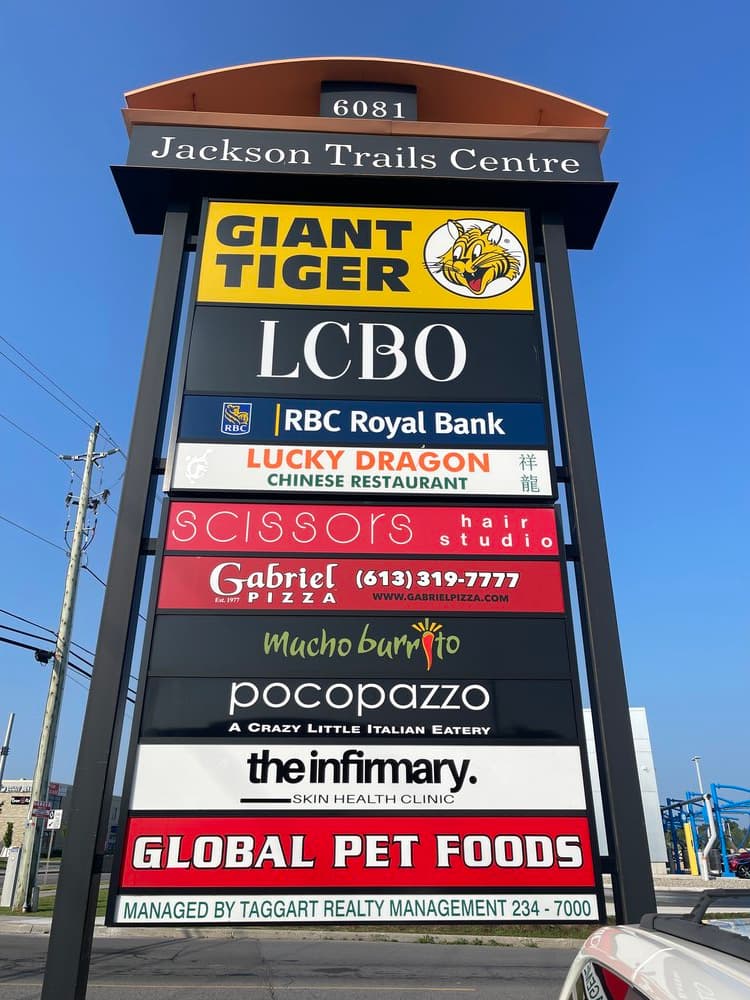
Property management signage: how wayfinding and identity signs drive tenant perception and retention
UC 2012 - Rexhausen, Hildebrandt and Auffrey's The Economic Value of On-Premise Signage at the University of Cincinnati Economics Center - documented a San Diego auto-dealer case study inside the broader research. When one dealer was forced to relocate a sign for code compliance, 21% of that dealer's customers afterwards reported difficulty finding the business. 68% of customers said signage was important to locating the business in the first place.
Translated to a multi-tenant plaza or office building: if your property pylon went dark for a month, what fraction of your tenants' customer base would lose the building? Property managers who treat the question as serious tend to invest in signage as property infrastructure. Property managers who treat it as a tenant problem tend to lose tenants when the lease comes up.
This is the case for taking commercial property signage in Ottawa seriously as a property asset, the wayfinding research behind it, and what a well-run multi-tenant signage program looks like in practice across our service area.
What property signage actually does for tenants
A plaza or office-building identity sign is doing four things at once for every tenant in the building:
Identification. It tells passing traffic that this is the building where the tenant operates. For a service business that depends on customers finding the door, the property sign is doing the first part of the wayfinding chain.
Trust. A well-maintained property sign signals that the building itself is being managed professionally. A faded panel, a missing letter on the pylon, or a directory board with handwritten paper inserts signals the opposite. Prospective tenants reading the building from the street draw conclusions about how the property is run.
Wayfinding once on site. Directional signage from the parking lot to the entrance, suite-number signage at the door, and tenant directory boards in the lobby all carry customers the rest of the way once they have arrived.
Tenant retention. A tenant whose signage performs well is a tenant whose customers can find them, whose business renews, and who is less likely to look at the lease end date when it approaches. A tenant whose customers cannot find them is a tenant looking at relocation options.
The fourth point is the one most undervalued by property managers. Signage is a property asset that the property manager controls directly. The tenant cannot upgrade the plaza pylon. The tenant cannot rebuild the master directory. The tenant cannot retrofit the LED in the cabinet sign. Those decisions sit with the property manager, and they meaningfully affect whether the tenant's business performs at this site.
The wayfinding finding
The UC 2012 data on directional and identity signage is consistent with USD 1997's broader findings. Pier 1's directional sign work in that study produced weekly sales lifts of 4 to 12 percent across the studied locations, averaging around 10%. The mechanism is straightforward: directional signs convert near-misses into completed visits.
The Institute of Transportation Engineers impulse-stop data gives a useful frame for plaza-scale tenants:
| Category | Impulse-stop rate | |----------|-------------------| | Service stations | 45% | | Fast food | 40% | | Convenience stores | 40% | | Shopping centres under 100K sq ft | 35% | | Sit-down restaurants | 15% |
Sub-100K-square-foot shopping centres run impulse-stop rates around 35%. That is the population of customers who decide to enter the plaza based on what they see from the road or parking lot. Plaza signage that fails to communicate the tenant mix, or that buries individual tenants on a hard-to-read cabinet, leaves a meaningful share of those customers on the road.
USD 1997's broader finding - +4.75% annual sales lift per additional on-premise sign - applies to plaza-scale property signage as much as to individual storefronts. Adding a clear master directory panel, refreshing the pylon, or adding directional signage from a key entry is each an additional sign that the research treats as additive, not redundant.
Pylon signs and multi-tenant identity
The design discipline that separates a working multi-tenant pylon from a frustrating one is the tenant hierarchy. Every plaza pylon makes hierarchy choices: which tenant gets the top panel, which tenants share equal-weight panels, how many tenant slots exist, and whether the property identity itself appears at the top of the structure or is integrated with the anchor tenant.
What goes wrong with most plaza pylons in Ottawa is one of three things:
The anchor tenant takes the entire top panel. That leaves the smaller tenants competing for narrow secondary slots that read as decoration from the road. The anchor benefits. The smaller tenants do not. When those smaller tenants come up for renewal, the signage is part of the reason they consider other plazas.
The cabinet sign is built once and never refreshed. Twenty-year-old pylon cabinets in Ottawa often run early-generation fluorescent or first-generation LED illumination. The light output has degraded, the colour temperature has shifted, and the panels are weathered. Replacement panels, an LED retrofit, or both can produce most of the visibility lift at a fraction of the cost of a full pylon replacement.
The wayfinding from the pylon to the tenant entrance is missing. A customer who reads the pylon, turns into the parking lot, and then cannot find the specific tenant entrance is a near-miss. Directional signage from the parking lot edge to the tenant entry closes that gap.
For property managers running multi-tenant plazas in Ottawa, Kingston, Brockville and Gatineau, the commercial property signage page outlines what a coordinated identity, pylon and wayfinding program looks like. The decision is rarely all-or-nothing: a panel refresh and an LED retrofit on an existing pylon, combined with new wayfinding from the parking lot, often delivers most of the visibility lift at a smaller capital outlay than a full pylon replacement.
LED cube and modular LED panel technology has changed plaza pylon economics over the past decade. For pylons in good structural condition, a modular LED retrofit can convert a tired cabinet sign into a current-spec illuminated panel without rebuilding the steel. For pylons whose structure has aged out, a full replacement is the cleaner decision.
The tenant-retention angle
Property managers who track tenant retention closely tend to find a pattern. The tenants who renew are the ones whose business is performing at the site. Among the factors affecting tenant performance, signage and wayfinding sit close to the top for any tenant whose customer acquisition depends on being found.
The cost of a tenant churn event - vacancy carry, tenant-improvement allowance, leasing commissions, build-out time - is substantially larger than the cost of upgrading the plaza signage that contributes to the tenant's performance. Property managers who model that comparison tend to invest in signage as a tenant-retention spend, not as a deferred capital line. Property managers who treat signage as a tenant problem ("if you want better visibility, that is on you") tend to find the same tenants negotiating harder at renewal.
UC 2012's finding that underperforming locations saw roughly 15% sales lift after sign upgrades applies inside the tenant base too. The plaza's weakest-performing tenants are often the ones whose signage is least well-served by the current property identity program. Refreshing the master plaza signage program often improves their performance directly, which improves retention indirectly.
For broader context on the underlying research, see the business case for storefront signage research summary. For franchise tenants specifically, the same logic produces the Pier 1 multi-location finding - the worst-performing sites carry the most available lift.
The maintenance reality
Most plaza pylons in Ottawa are 15 to 25 years old. The original fabrication may have been quality work for its era. The illumination spec, the panel technology, and the structural condition all age. The question is rarely whether the existing pylon needs attention. It is whether the right intervention is a panel refresh, an LED retrofit, a structural assessment, or a full replacement.
A useful sequence for a property manager looking at an aging pylon:
Structural assessment first. A licensed structural inspection of the pylon and footings tells you whether the existing structure is sound for another decade or needs replacement. That is the variable that determines whether retrofit makes sense.
Illumination spec next. If the structure is sound, an LED retrofit using modern modular panels typically produces a meaningful visibility improvement at a fraction of full replacement cost. The energy consumption drops substantially as a side benefit.
Panel refresh. Cabinet faces, individual tenant panels, and any digital messaging components can be refreshed independently of the steel. This is the lowest-cost intervention and often produces the largest visible change.
Wayfinding additions. New directional signage from the parking lot, refreshed tenant suite identification, and lobby directory boards close the wayfinding chain from the pylon to the tenant door.
Sign permits in Ottawa covers the regulatory side of pylon work. Replacement pylons and substantial pylon modifications require City of Ottawa permits. Most panel refreshes and LED retrofits do not, although the exact threshold depends on the specific work.
The permit and landlord-coordination flow
A common pattern in multi-tenant plazas is that individual tenants approach the property manager wanting to upgrade their fascia or panel signage. The property manager then decides on a case-by-case basis. The fragmented approach produces inconsistent results across the property and rarely captures the available lift on master plaza signage.
The cleaner approach is for the property manager to drive a master sign program. The master sign program documents permitted letter heights, illumination spec, panel positions, and the process for tenant fascia and pylon panel additions. Tenants applying for sign permits work through the master program rather than through one-off negotiations.
For property managers in Ottawa, the commercial property signage page outlines what a master sign program covers. For the City of Ottawa permit process specifically, sign permits in Ottawa walks through the application flow.
Property managers who run master sign programs tend to find that the program pays for itself in faster tenant turnover (less time spent negotiating one-off sign requests), more consistent property appearance, and stronger tenant retention.
What this changes for the property manager
A property manager running a 40,000 square foot multi-tenant plaza in Ottawa or Kingston with an aging pylon and inconsistent tenant fascia work is sitting on a capital decision that the research treats as one of the highest-return categories of property spending available. A full pylon refresh, master sign program documentation, and coordinated tenant fascia program can run in the low-to-mid five figures. The retention effects on existing tenants, combined with the leasing effects on new tenants and the customer-acquisition effects on every tenant in the property, typically produce a payback period measured in months rather than years.
For property managers, building owners, and commercial real estate operators across Ottawa, Kingston, Brockville, Gatineau and the rest of the 200 km service area, the case for treating signage as property infrastructure rather than a tenant problem is the most underused operating lever in the portfolio.
About Lundon Calling
Lundon Calling is a full-service commercial signage company based in Ottawa, serving Eastern Ontario and Western Quebec. We design, permit, fabricate, and install exterior and interior signage for commercial property managers, multi-tenant plaza owners, office building operators, and dental and healthcare practices across a 200 km service radius - including Kingston, Brockville, Cornwall, Smiths Falls, Pembroke, Belleville, Gatineau, and Hawkesbury.
Contact us today for a complimentary signage assessment.
(613) 854-9255 info@lundoncallinginc.com lundoncallinginc.com