Sign payback math: real case studies and what to expect at your site
A $5,000 storefront sign is not a $5,000 expense. It is a capital investment in an asset that will work twenty-four hours a day, seven days a week, for the next ten-plus years. Treated as an expense, the question is "can we afford it?" Treated as a capital investment, the question is "what is the payback period, and what is the asset doing for the next decade after it pays for itself?" The research has decent answers to both.
This is the case for thinking about signage as a capital decision, three documented examples of what payback periods actually look like in practice, and a five-minute model to estimate the payback period for an Ottawa storefront before committing to the spend.
Why payback math is the right framework
Signage is a durable asset. A quality channel letter, illuminated cabinet, or pylon sign installed to current spec has a working life of roughly 8 to 12 years before substantial refresh is needed. The accounting treatment in most Canadian jurisdictions reflects that durability: signage is capitalized and depreciated, not expensed. For the plain-English version of that argument, see how outdoor business signs pay for themselves.
Treating signage as a line-item expense distorts the spending decision in two ways. First, the comparison set becomes other line-item expenses (rent, utilities, marketing campaigns) that are inherently smaller and recur annually. A $7,500 capital decision looks oversized next to a $500 monthly marketing line. Second, the time horizon collapses. The benefits of the sign are spread across ten years; the expense is concentrated in one. The decision feels worse than it is.
Treating signage as a capital investment reverses both distortions. The comparison set becomes other capital investments (equipment, leasehold improvements, vehicles, furniture). The time horizon stretches to the working life of the asset. The math becomes a payback period calculation, which is the same framework used for any other capital decision in the business.
The research base for the lift assumptions, USD 1997 and UC 2012, is summarized in the business case for storefront signage research summary.
Case study one: Frenchy's Bistro
The Frenchy's Bistro case is widely cited in signage-industry literature. The business replaced a flat one-dimensional sign with a backlit storefront sign. The documented sales lifts: 16% in year one, 32% in year two, and over 300% across four years.
The case is anecdotal in the methodological sense. It is one location, one operator, one before-and-after comparison without a control group. The lift cannot be cleanly separated from other operational changes that may have happened at the same time. As a single data point, it is illustrative rather than definitive.
The reason to cite it anyway: the order of magnitude is consistent with the academic research. USD 1997's regression coefficients for new building signs in the 5 to 15 percent annual lift range, applied compoundingly over four years and combined with the secondary effects of an improved storefront on word-of-mouth and repeat traffic, can produce four-year cumulative lift figures in the range Frenchy's reported. The case is not implausible. It is one operator's documented experience inside a category and range the regression models predict.
Case study two: Belmont Auto Spa
The Belmont Auto Spa case is also widely cited. The business invested approximately $15,000 in a pole sign. Detailing-service sales grew 125%. Overall sales grew 15%. The sign paid for itself in six weeks.
Same methodological caveat as Frenchy's. One location, one operator, no controlled comparison. The order of magnitude is again consistent with the underlying research. A new pole sign at a previously underserved site, in a high-impulse-stop category (service stations and auto-services run at the top of the ITE impulse-stop table at roughly 45%), is the category where the largest absolute revenue lifts in USD 1997 were observed.
Six-week payback on a $15,000 capital investment producing 15% top-line lift on a business doing meaningful annual revenue is arithmetically straightforward. If the business was doing $1.5M before the sign, 15% is $225,000 of incremental annual revenue, which is roughly $4,300 per week. A $15,000 sign at $4,300/week of incremental revenue pays back in three and a half weeks. The reported six-week payback implies a slightly more modest revenue baseline. Either way, the payback period is measured in weeks, not years.
Case study three: the Pier 1 100-store time-series
USD 1997 - Ellis, Johnson and Murphy at the University of San Diego School of Business - included a hundred-store Pier 1 time series over seven years. Building-sign upgrades produced weekly sales lifts ranging from under 1% at the best-performing stores up to 23.7% at the bottom-quartile stores. The mean lift was roughly 5%. When a primary sign upgrade was paired with two minor signage additions, the combined weekly lift averaged about 16%. That additive effect is the basis for the 4.75% per-sign revenue rule.
This is the methodologically strongest of the three cases. One hundred locations, seven-year time-series, multiple regression controls. The variance across the hundred stores is the most useful part of the finding. The mean lift of 5% is consistent. The distribution is what most operators have not heard.
Translated to payback: at the mean 5% lift, a typical $7,500 sign installation on a $500,000 storefront produces $25,000 of incremental annual revenue and a payback period of roughly 3.6 months. At the bottom-quartile 23.7% lift, the same $7,500 sign on a previously underserved site can pay back in weeks. At the top-quartile sub-1% lift, the same sign produces only marginal incremental revenue, and the payback extends to multiple years.
The Pier 1 distribution is the empirical basis for the recommendation in the franchise signage piece: refresh the underperforming sites first. That is where the payback periods are measured in weeks. The strong sites are not the priority; they have already captured most of the available lift.
For franchise operators specifically, see the multi-location signage problem.
A worked Ottawa example
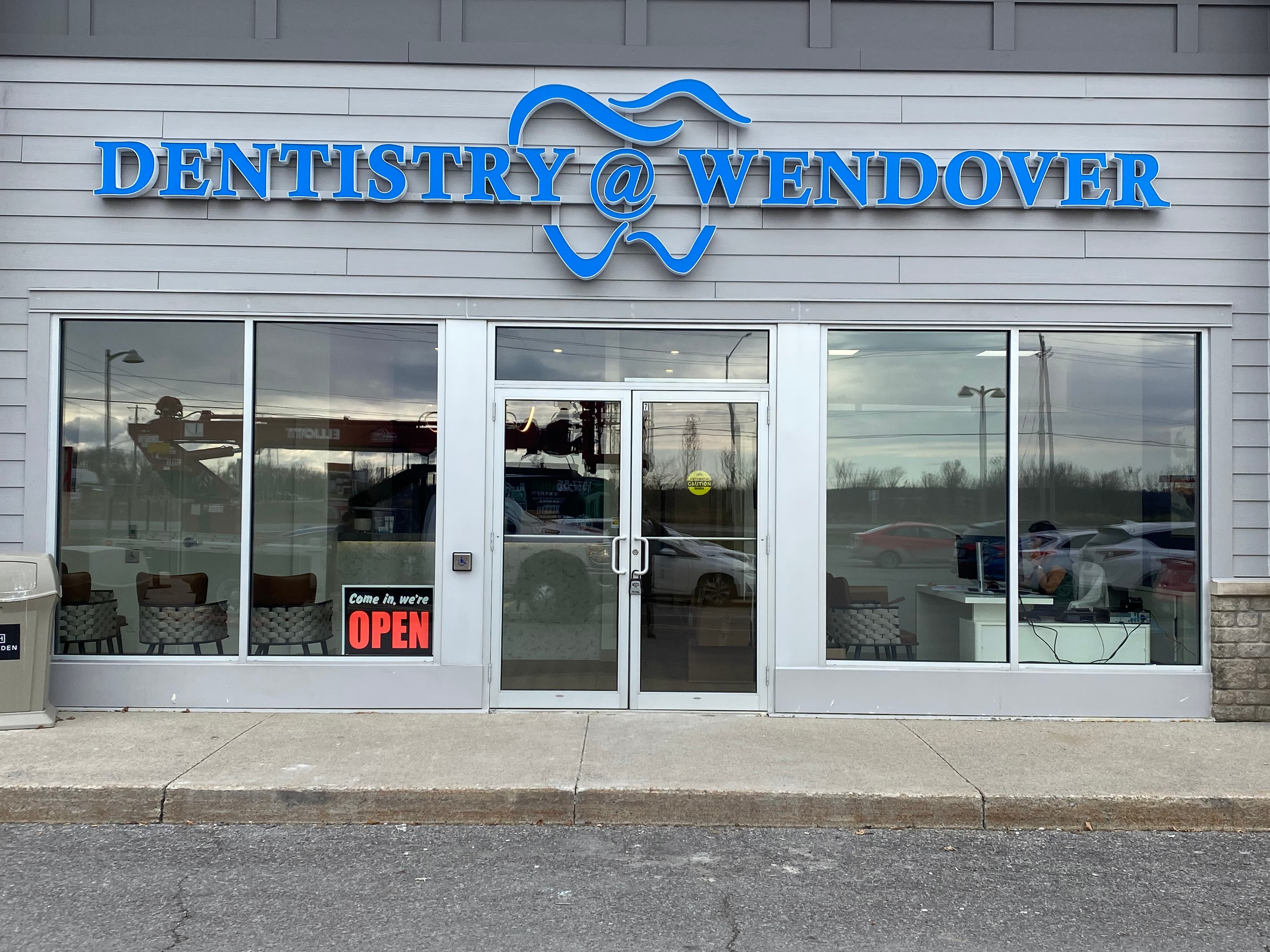
A hypothetical dental clinic in Ottawa doing $400,000 in annual revenue at a single location, considering a fascia refresh with channel letters and matching awning. The build runs $7,500 installed, including design, fabrication, and a single-day install.
Apply a conservative 5% revenue lift, well within the USD 1997 range for a new building sign on a site that has not been refreshed recently. That is $20,000 of incremental annual revenue. On a $7,500 installed cost, payback is approximately 4.5 months. The sign has a working life of approximately 10 years before substantial refresh is needed.
A simple ten-year asset value calculation: $20,000 incremental annual revenue à 10 years = $200,000 of lifetime asset value, against $7,500 installed cost. That is a return on investment ratio of roughly 27:1 over the working life of the sign, undiscounted. Discounted at a reasonable cost of capital (call it 10% annual), the net present value of the lift over 10 years is approximately $123,000, against a $7,500 cost. NPV is still strongly positive even at conservative discount rates.
For a $1.2M Ottawa dental practice at 5% lift, the math runs $60,000 of incremental annual revenue, payback in roughly 1.5 months on a typical $10,000 to $15,000 dental clinic fascia refresh, lifetime asset value north of $600,000, and an NPV at 10% discount of approximately $369,000 on a $12,500 cost.
The reason the math is unsubtle is that the underlying lift coefficient (5%) is conservative inside the research range, and the asset life (10 years) is realistic for a properly specified channel letter sign. Most decisions that produce 27:1 lifetime returns are not lingering capital decisions. Storefront signage, when properly specified for the site and the category, does.
The honest caveats
Three caveats worth saying directly.
Industry-sponsored studies. USD 1997 was funded by the California Sign Association and the International Sign Association. UC 2012 followed a similar model. The methodologies are rigorous and the findings have been replicated, but the funding source is not neutral. Read the studies, weigh the methodology, and treat the coefficients as the best available estimates, not as guaranteed outcomes.
Anecdotal status of Frenchy's and Belmont. Both cases are widely cited in signage trade literature and both are illustrative. Neither is peer-reviewed in the way USD 1997 and UC 2012 are. Use them as examples of what payback math can look like when it lands at a specific site, not as predictions of what will happen at your site.
Categories where signage moves the needle less. Luxury and appointment-driven categories (high-end specialists, luxury retail, private wealth advisors), e-commerce-anchored brands with small physical footprints, and businesses with conversion bottlenecks downstream of the sign all see smaller lifts in the research. The payback math gets less favourable. For these categories, treat the lower end of the USD range as the working assumption.
How to model your own payback in five minutes
A simple framework that any owner-operator can run before going to a sign company:
Step 1. Estimate current annual revenue at the location where the signage decision applies. Use the most recent twelve months.
Step 2. Pick a conservative lift percentage from the research range. For an incremental sign on an existing primary, use 3 to 5 percent. For a new primary sign on a previously underserved site, use 5 to 10 percent. For a previously underserved site in a high-impulse-stop category (QSR, convenience, service stations), 10 to 15 percent is inside the documented range. Take the lower end if uncertain.
Step 3. Multiply current annual revenue by the lift percentage. That is the estimated annual incremental revenue from the signage decision.
Step 4. Divide the estimated annual incremental revenue by 12. That is the estimated monthly incremental revenue.
Step 5. Divide the installed sign cost by the estimated monthly incremental revenue. That is the payback period in months.
Step 6. Multiply the estimated annual incremental revenue by the expected sign life (use 10 years as a default). That is the lifetime asset value before discounting.
If the payback period from step 5 comes in under twelve months, the decision is usually clear. If it comes in at one to three years, the decision deserves more diligence on category, site and competitive context, but is generally favourable. If it comes in past three years, the assumptions deserve scrutiny. Either the lift assumption is too optimistic for the category, or the sign cost estimate is high for the spec.
This framework is rough. Operators wanting more precision can apply category-specific lift assumptions, model the lift conservatively in year one and ramping in year two, and discount the future cash flows at a chosen cost of capital. The simple version is the right starting point. The full discounted-cash-flow model rarely changes the decision direction.
For an Ottawa-specific signage assessment that includes site audit, lift assumptions calibrated to the category and the site, and an installed-cost estimate, contact us. For dental clinic signage specifically, the dental industry page includes the typical refresh program scope and cost range.
About Lundon Calling
Lundon Calling is a full-service commercial signage company based in Ottawa, serving Eastern Ontario and Western Quebec. We design, permit, fabricate, and install exterior and interior signage for small and mid-sized businesses, dental and healthcare practices, commercial property managers and franchise brands across a 200 km service radius - including Kingston, Brockville, Cornwall, Smiths Falls, Pembroke, Belleville, Gatineau, and Hawkesbury.
Contact us today for a complimentary signage assessment.
(613) 854-9255 info@lundoncallinginc.com lundoncallinginc.com