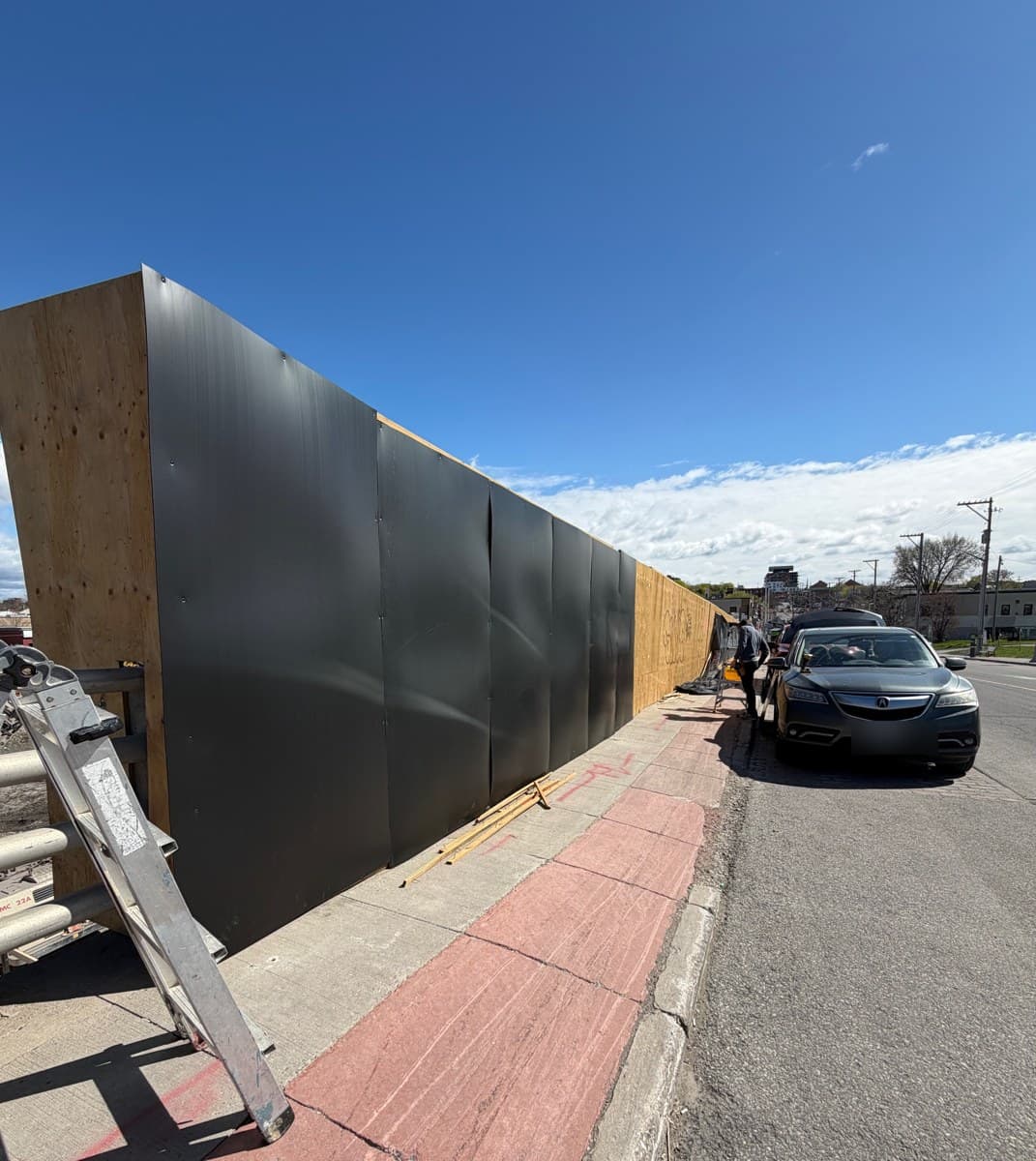
The 200-foot billboard most developers throw away
Your construction hoarding is in front of more eyeballs than most billboards. You are treating it like a fence.
A typical Ottawa mid-rise hoarding sits in public view for 18 to 36 months, on a busy street, at car-window and pedestrian-eye height. That is longer than most billboard contracts. Most developers treat the same surface as compliance plywood: bare lumber, weathered notices, the occasional fly-poster, eventual graffiti. The lumber cost is identical either way. The marketing surface either works for the project or it does not.
The math nobody runs
Industry estimates put on-premise outdoor signage CPM in the range of roughly $0.02 to $0.15. Out-of-home billboard CPMs run substantially higher. The hoarding is already a sunk cost: a code-compliant fence has to go up regardless of whether the developer wraps it or leaves it bare. The incremental cost of wrapping it properly is small. The incremental output across an 18-to-36-month exposure window is not.
USD 1997 - Ellis, Johnson and Murphy's The Economic Value of On-Premise Signage at the University of San Diego School of Business - did not study construction hoarding specifically, but the underlying coefficients translate. Each additional on-premise sign was associated with a 4.75% revenue lift, statistically significant at the 95% confidence level. The Outdoor Advertising Association of America (OAAA) and the US Small Business Administration's Signage Sourcebook both treat on-premise outdoor signage as among the most cost-effective customer-acquisition surfaces a business can own.
For a developer running a pre-leasing or pre-sales campaign through Google and Meta in parallel with the build, every email or call that originates from the hoarding is a lead that did not require paid digital spend. For 18 to 36 months. On a surface that was already going up.
What a working hoarding does
A properly wrapped construction hoarding does four things at once:
It announces the project to the neighbourhood. Residents and businesses on the street know what is being built and when.
It markets pre-leasing or pre-sales. A headline like "APARTMENT RENTALS COMING SOON" or "COMMERCIAL SPACE FOR LEASE" with a contact email or QR code turns the fence into a lead-gen channel.
It signals neighbourhood-trust competence. A neat, clearly branded hoarding tells residents and businesses on the street that the project is being run carefully. A bare plywood wall signals the opposite. The reputational difference is meaningful at lease-up.
It integrates the regulatory copy. DANGER, Construction Zone, Do Not Enter and code-required notices appear at code intervals, sized to be legible without dominating the brand work above them. Compliance and marketing share the same surface.
What this looks like in Little Italy
The Taggart Group hoarding on Preston Street in Little Italy is a working example. The 200-foot wrap on a residential mid-rise build coordinates three Taggart-family brands - Doran Contractors handling general contracting, Taggart Realty Management overseeing leasing, and Taggart Construction Limited handling civil and site work - on one continuous wall. A repeating pattern along the Preston frontage runs the Doran "D" corporate mark, the APARTMENT RENTALS COMING SOON headline, and the Taggart Realty leasing email, then resets. At the corner, the Taggart Construction panel takes over the face most visible to incoming site traffic. The repeating pattern means traffic flowing in either direction on Preston Street catches the complete message at least once. The full case study with installation photos is here: Taggart / Doran construction hoarding wrap, Preston Street.
The wrap is doing work for the project from the day the fence goes up. The first place a member of the public sees that the three Taggart brands are the same family of companies behind the build is the hoarding, not the lease-up campaign.
The takeaway
If you are starting a build in Ottawa, Eastern Ontario or Western Quebec in the next six months, design the hoarding wrap before the fence goes up, not after. The panel breaks, the brand hierarchy, the regulatory copy positions, and the material spec (ACM for high-traffic pedestrian streets like Preston; coroplast for shorter cycles or quieter sites) all need to be locked before the lumber is ordered. A wrap designed in parallel with the fence install integrates cleanly. A wrap retrofitted after the fact produces awkward seams and leaves three to six weeks of unwrapped exposure on the street.
For developers, GCs and property managers planning a build, the construction signage page covers the typical hoarding program. The longer case for treating construction hoarding as a marketing asset includes the full CPM math, the multi-brand layout problem, and practical specs that hold up across an 18-to-36-month exposure.
The fence has to go up. The marketing surface is included in the lumber. The decision is whether to use it.
About Lundon Calling
Lundon Calling is a full-service commercial signage company based in Ottawa, serving Eastern Ontario and Western Quebec. We handle construction hoarding wraps, fence scrims, and project signage for general contractors, developers and property managers across a 200 km service radius.