Bilingual signage in Eastern Ontario: why French hierarchy isn't a compliance question, it's a trust question
In Eastern Ontario and Western Quebec, French is not decoration. A sign that treats French as smaller, lighter, or visually secondary signals to the local market that the business does not take French-speaking patients or customers seriously. Patients walking up to a clinic, customers walking up to a storefront, and tenants reviewing a plaza directory all read the hierarchy correctly, whether the sign vendor intended it or not. Local pride is real and customers notice.
This is the case for treating bilingual signage in Ottawa, Gatineau and Hawkesbury as a trust decision rather than a compliance afterthought, why the hierarchy gets it wrong so often, and what a properly executed bilingual sign actually looks like in practice. It is also the case for out-of-market signage companies considering a regional partner for the Eastern Ontario and Western Quebec leg of national franchise rollouts.
The Quebec language compliance baseline
For commercial signage in Quebec - including any Gatineau-side location of an Ottawa-Gatineau business - the legal baseline is set by the Charter of the French Language and the amendments under Bill 96. The requirement is that French appear with markedly greater predominance on commercial signage in Quebec. The specific interpretation of "markedly greater predominance" has been clarified through subsequent regulation; in practical terms, French letterforms typically occupy approximately twice the visual space of any other language present on the sign, with the precise ratio depending on layout and material.
For Ottawa businesses with a Gatineau location, the compliance question is non-negotiable. The sign that works on the Ottawa side cannot be cloned to the Gatineau side without redesign. The Gatineau fascia is its own design problem, with French in markedly greater predominance, and bilingual layout discipline that respects both the law and the customer base.
This is not a place to overclaim on legal specifics. A business operating across the Ottawa River should consult Quebec language law directly and confirm current interpretation with counsel where appropriate. The point for this piece is that the compliance baseline exists, is enforced, and shapes the design decision for any sign that will appear in Quebec.
The Eastern Ontario reality
Eastern Ontario does not impose a Quebec-style compliance regime on French-language signage. Hawkesbury, parts of Cornwall, parts of Ottawa east of the Rideau, and pockets of the rural service area sit inside the bilingual corridor that runs along the Ottawa River and into the Saint Lawrence valley. The francophone population in these communities is large enough that customer expectations around bilingual signage closely mirror those on the Quebec side, even where the law does not require it.
The decision a business in Hawkesbury, Embrun or rue Notre-Dame in Old Hull faces is not a compliance decision. It is a market decision. Treating French as equal-weight on the sign signals to the local market that the business serves French-speaking customers as full first-class customers, not as a secondary segment that the English-language sign accommodates as an afterthought.
The demographic context behind that decision varies community by community and changes over time. This piece does not cite specific population figures because those numbers move and the exact composition of each community is a matter of public record best confirmed against current Statistics Canada data. The general point is uncontroversial: in the bilingual corridor that runs through the Ottawa-Gatineau-Hawkesbury triangle, French-speaking customers are not a niche segment. Signage that treats them as one signals the wrong thing.
The hierarchy mistake
The most common bilingual signage mistake in Eastern Ontario is hierarchy by accident. A sign vendor receives the brief - the business name, the secondary descriptor, the contact information - and lays out the sign in the working language of the office staff (typically English on the Ottawa side, French on the Gatineau side). The translation into the other language is then added as a secondary line, set 75% of the size of the primary, sometimes in italic, sometimes on a smaller secondary panel.
None of those choices are language-neutral. A patient or customer walking up to the door reads the hierarchy as a statement of priority. The visual hierarchy says: this language is the main language of this business; the other one is included because we should, not because we mean it.
The fix is not to translate the sign twice and run two identical signs. The fix is to design the bilingual lock-up so the two languages share the same weight, the same letter height, the same channel construction, and a clear vertical or horizontal hierarchy that reflects the working language of the patient or customer base at the specific site - not the working language of the office staff.
For a clinic in Hawkesbury where most patients walking up to the door are francophone, "Clinique Dentaire" sits on the top line and "Dental Clinic" sits directly underneath, same weight, same size, same face-lit channel construction. For a clinic in west Ottawa where most patients are anglophone but a meaningful French-speaking patient base exists, the order may be reversed, with the size, weight and treatment identical. Either way, the patient walking up does not read the hierarchy as a statement that one language is less important than the other.
The Floss Dental Plaza Hawkesbury example
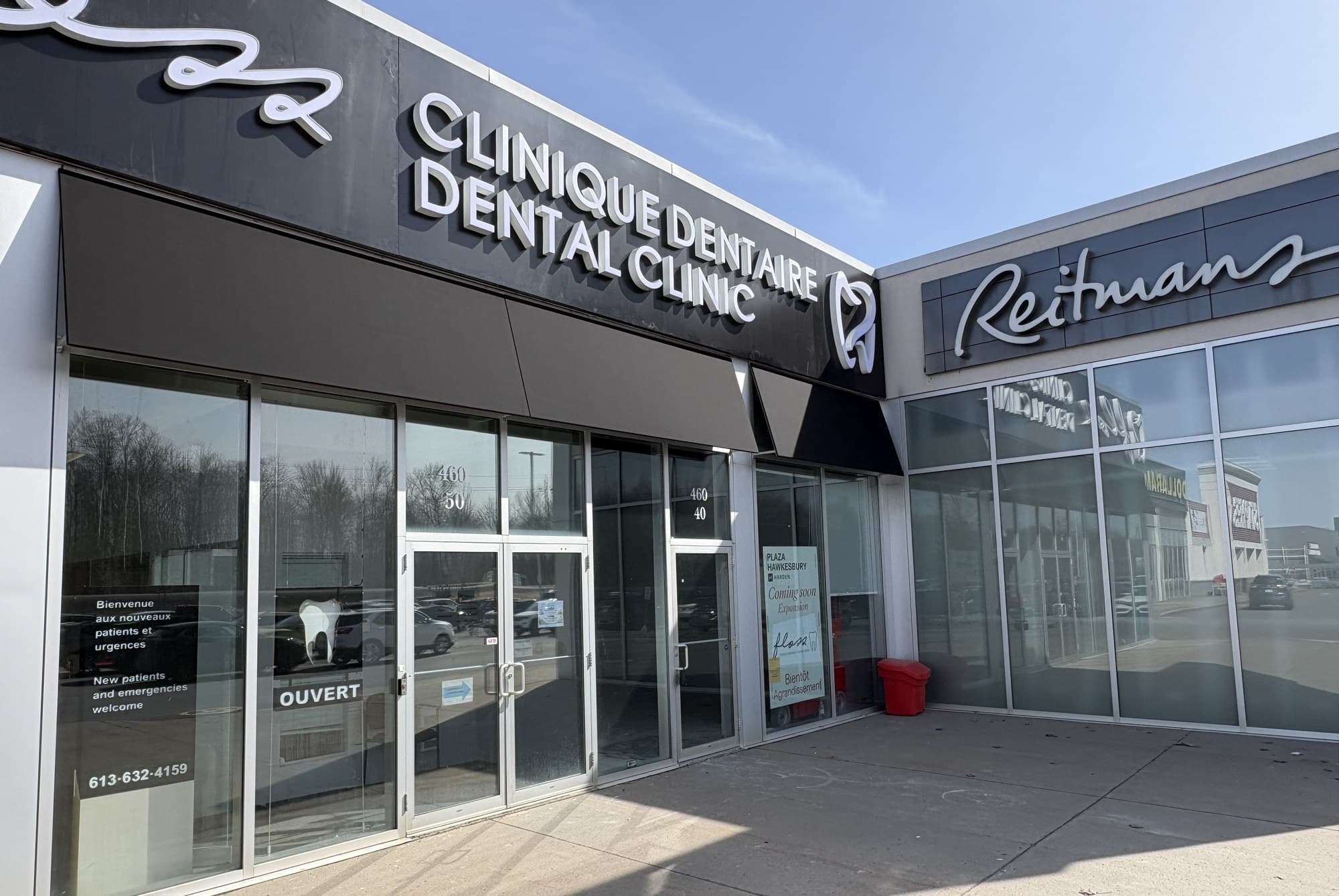
The Floss Dental Clinique Dentaire installation at Plaza Hawkesbury is the working example of the principle. The plaza sits at the eastern edge of Ontario, in one of the most consistently francophone corridors in the province. The patient base walking up to Floss Dental at 460 Spence Avenue is predominantly French-speaking, with a meaningful English-speaking minority.
The bilingual lock-up on the fascia reads "CLINIQUE DENTAIRE" on the top line, "DENTAL CLINIC" directly underneath. Same weight. Same point size. Same face-lit channel letter construction. The hierarchy reflects the working language of the patient base at this specific location, not the working language of the office.
The same discipline carries through to secondary signage. The door decals, the entry "OUVERT" sign, and the temporary window notice during the build-out all use the same equal-weight treatment. There is no point on the storefront where French is set smaller, lighter, or in italic. There is no point where the bilingual hierarchy slips.
The full case study, including the RGB LED tooth medallions and the practical detail on how the sign was specified and installed, is here: Floss Dental Hawkesbury bilingual channel letters with RGB LED. For dental clinic signage across Ottawa, Hawkesbury, Gatineau and Kingston, the dental industry page covers the typical bilingual program in dental.
What this means for out-of-market signage companies
The bilingual layout discipline is genuinely hard to get right from outside the region. A signage company based in Toronto, Mississauga or southern Ontario can read the brand brief, translate the copy correctly, and produce a technically accurate bilingual sign. What is harder is reading the local market correctly: which language carries the primary line at this specific Hawkesbury plaza, what weight ratio the local market reads as equal-weight rather than condescending, how the bilingual hierarchy interacts with the brand identity guidelines a national franchise has imposed.
This is one of the most common reasons national franchise rollouts use a regional install partner for the Eastern Ontario and Western Quebec leg. The fabrication can stay with the national vendor or shift to local production. The install consistency and the bilingual layout review come from a partner who works the bilingual corridor every week. The trade partner program at Lundon Calling is built for exactly this scenario: national vendors who want their Eastern Ontario and Western Quebec installs handled by a partner who knows the bilingual layout discipline from working the region every week.
The decision for the national sign vendor is rarely whether the bilingual sign is technically possible to produce out-of-market. It usually is. The decision is whether the bilingual sign that arrives at the site has been reviewed by someone who reads the local market correctly. For a franchise rollout with locations in Ottawa, Gatineau, Cornwall and Hawkesbury, that review is the difference between a sign that lands well in the community and a sign that signals "this national brand has not really thought about French-speaking customers."
For franchise operators specifically, see the multi-location signage problem and the Pier 1 100-store study.
Practical specs for bilingual signage
For businesses commissioning bilingual signage in Ottawa, Gatineau, Hawkesbury or anywhere in the bilingual corridor, the practical specs that matter:
Letter height parity. Both languages should appear at the same letter height. The visual perception of equal weight depends on letter height before anything else. A French line set at 80% of the English letter height reads as secondary, even if the font weight and treatment otherwise match.
Font weight matching. Both languages should use the same font weight. Setting English in bold and French in regular weight, or vice versa, signals hierarchy even at matched letter heights. The standard is identical weight and identical font face.
Vertical and horizontal hierarchy. Bilingual lock-ups can be vertical (one language on top, the other directly underneath) or horizontal (one language on the left, the other on the right). Both work. The choice depends on the available fascia geometry and the brand identity. What matters is that the secondary position does not become a treatment that visually downgrades the secondary language.
Channel letter construction parity. For illuminated channel letter signs, both languages should use the same channel construction. Setting English as face-lit channel and French as flat vinyl applique signals dramatic hierarchy difference. The standard is identical channel construction, identical lighting spec, identical return depth, identical face material.
Permit submission in both languages from the start. Permit submission documents to the municipality (and any required submissions to the Office québécois de la langue française for Quebec-side installs) should include both language versions of the sign from the initial submission. Adding the French version later is more expensive and more likely to introduce hierarchy inconsistencies.
Quebec sign installs require additional French-predominance verification. For Gatineau-side installs, the markedly greater predominance requirement under Bill 96 requires explicit visual ratio verification, typically that French occupies approximately twice the visual space of any other language on the sign. The exact ratio depends on current regulation and should be confirmed against current Office québécois de la langue française guidance at the time of fabrication. For more on Quebec-specific compliance, sign permits in Ottawa and the broader region covers the regulatory side at a high level.
What this changes for the operator
For a business operating in the Ottawa-Gatineau-Hawkesbury corridor, the bilingual hierarchy decision is one of the higher-leverage decisions on the storefront sign. Get it right and the sign performs as a trust signal to both language communities. Get it wrong and the same sign signals to half the local market that the business considers them secondary. The cost difference between getting it right and getting it wrong is zero - the fabrication and install cost is the same. The market response is not.
For dental, healthcare, retail and service businesses across our 200 km service area, the bilingual layout review is a default part of the design process, not an upcharge. For multi-location franchise operators and out-of-market signage companies considering a regional partner, the same discipline carries through to the trade partner program.
About Lundon Calling
Lundon Calling is a full-service commercial signage company based in Ottawa, serving Eastern Ontario and Western Quebec. We design, permit, fabricate, and install bilingual exterior and interior signage for dental and healthcare practices, commercial property managers, franchise brands and general contractors across a 200 km service radius - including Kingston, Brockville, Cornwall, Smiths Falls, Pembroke, Belleville, Gatineau, and Hawkesbury. Bilingual fabrication, permit submission, and install in-house.
Contact us today for a complimentary signage assessment.
(613) 854-9255 info@lundoncallinginc.com lundoncallinginc.com