Why dental clinics underinvest in exterior signage (and what the research says it's costing them)
Taylor, Sarkees and Bang's 2012 study in the Journal of Public Policy and Marketing surveyed on-premise sign users directly. 85% said they would lose sales if they lost their sign. The average projected loss was around 35%.
Applied to a dental practice, the question becomes uncomfortable. If your storefront signage went away tomorrow - no fascia letters, no door identification, no plaza pylon panel - what fraction of new-patient acquisition would disappear with it? Most clinic owners have never asked. Most have never run any version of that math.
This is the case for dental practices taking signage seriously, what the research says it is worth, and what a refreshed clinic signage program actually looks like in Ottawa, Hawkesbury, Gatineau and Kingston.
The dental signage problem
Two patterns repeat across the dental clinics we visit.
The first: the signage was inherited. The clinic took over a leased space from a previous tenant, kept the existing illuminated cabinet or fascia letters, swapped the wordmark for the new practice name, and never revisited the decision. The construction is probably ten or fifteen years old. The illumination is single-colour fluorescent or early-generation LED. The letterforms reflect a different brand and a different era.
The second: the signage was built once, at the original buildout. It was specified by a contractor or interior designer with no specific signage expertise, treated as a finishing line item, and never refreshed. The original spec rarely accounts for night visibility, bilingual hierarchy, or the difference between a sign that satisfies a landlord and a sign that earns appointments.
Neither pattern is a strategic decision. Both are the absence of one. The research on what a properly specified exterior sign does for revenue is consistent enough that the absence is expensive.
What new patients actually notice
The FedEx Office 2012 consumer signage survey, n=914, asked consumers what signs actually do to purchasing behaviour.
76% of consumers say they have entered a store solely because of a sign. For a dental clinic, the equivalent question is whether a patient considering a new practice notices yours from the street, in the plaza directory, or in the lineup of healthcare options on a corridor like Bank Street, March Road, or rue Principale in Hawkesbury.
68% say they purchased after entering a store because of a sign. Translated to dental: the sign got them into the clinic; the visit converted to a booked appointment.
75% say they have told someone else about a business they discovered because of a sign. Word-of-mouth in dental is large and well-documented. A new patient who finds a clinic because the storefront looks credible tells family members, coworkers and neighbours.
The BrandSpark/Better Homes & Gardens 2012 supplemental signage module adds the most concerning number for clinics with weak signage. 60.8% of consumers report they have failed to find a business at some point because the signs were too small or unclear. A first-appointment patient who cannot find the clinic on the first attempt does not always reschedule. A meaningful share of them switch to the next clinic on their list.
That is the cost of an inherited sign that nobody has revisited. The clinic owner does not see it, because the patients who never showed up are not in the chart system.
The bilingual question in Eastern Ontario and Western Quebec
In Hawkesbury, Gatineau, parts of Cornwall and parts of Ottawa east of the Rideau, French is not a compliance afterthought. It is the working language of a meaningful portion of the patient base. A sign that treats French as smaller, lighter, or visually secondary signals to the local market that the practice does not take French-speaking patients seriously. Patients read that as a statement about the kind of clinic this is.
Done well, bilingual hierarchy is invisible. "Clinique Dentaire" and "Dental Clinic" appear in the same weight, same letter height, and same channel-letter construction. The order on the sign reflects the working language of the patient base at that specific location, not the working language of the office staff.
Done badly, bilingual hierarchy is the most common signage mistake in Eastern Ontario. French is set 75% of the size of English. French is set in italic to indicate "secondary." French appears on a smaller secondary panel and English carries the primary fascia. None of those choices are language-neutral, and patients walking up to the door read them correctly as a statement of priority.
For dental clinics in Gatineau specifically, French must appear with markedly greater predominance on exterior commercial signage under Quebec's language legislation. For dental clinics in Hawkesbury and parts of Cornwall, no compliance regime forces the question - but local market expectations mirror Quebec, and the clinics that treat French as equal-weight outperform clinics that treat it as decoration.
RGB LED and seasonal flexibility
A standard single-colour LED channel letter sign does its job. It illuminates the brand at night and lasts a long time. It is also a fixed asset. The colour temperature, the white point, and the visual signal are locked at fabrication.
RGB LED converts the sign from a fixed asset into a flexible one. The same channel letters that read clean white most of the year can shift to pink for Breast Cancer Awareness Month in October, red and white for Canada Day, green for December, or the practice's signature colour for special campaigns. The flexibility is on a remote, not on a service truck.
For a dental practice in a competitive market, the incremental cost over single-colour LED at fabrication is modest. The incremental marketing surface across a ten-year sign life is not. The same illuminated logo medallion that reads as healthcare-blue on a Tuesday in February can carry a pink awareness campaign three weeks later without a service call.
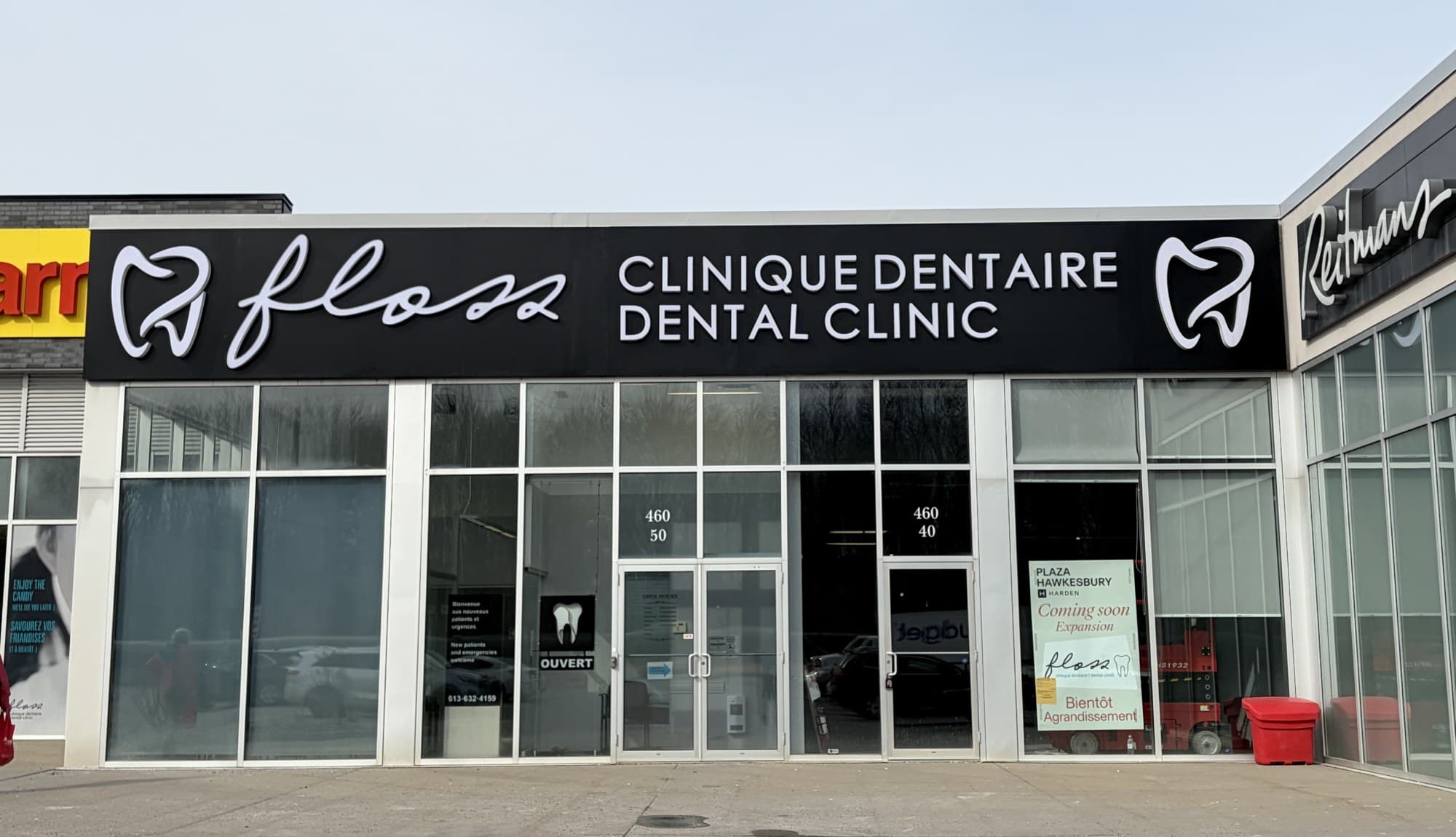
The Floss Dental Clinique Dentaire installation at Plaza Hawkesbury uses exactly this approach. Two halo-lit RGB tooth logo medallions flank the wordmark, controllable to any colour in the spectrum. The full case study is here: Floss Dental Hawkesbury bilingual channel letters with RGB LED.
A real example: Floss Dental Clinique Dentaire, Plaza Hawkesbury
Plaza Hawkesbury at 460 Spence Avenue is a standard-format suburban commercial plaza. National anchors, a busy parking lot, a fascia band where every tenant sign competes for attention in the same fixed architectural frame. Floss Dental expanded into the adjacent unit and needed a storefront sign that read clearly from across the parking lot in two languages, held its own against neighbouring national tenants like Reitmans and Mark's, and felt like a modern dental brand rather than a strip-mall clinic.
The build is a 1/8" black ACM pan fascia running the full width of the unit. Two illuminated Floss tooth medallions in halo-lit channel form with RGB LED interiors flank the wordmark. The "Floss" script is in white face-lit channel letters. The bilingual lock-up - "CLINIQUE DENTAIRE" on top, "DENTAL CLINIC" directly underneath, same weight and same construction - sits centred on the panel. A matching black awning above the entry doors ties the storefront identity back to the fascia band.
By day, the look is restrained: bright white letterforms on matte black, tooth medallions reading as crisp white outlines. By night, the RGB tooth logos shift to a deep medical blue that throws a soft glow onto the storefront columns and the wet pavement, while the wordmarks stay clean cool-white. Different mood, same sign, no service call required to change either.
For a clinic operating into the evening in a plaza where the parking lot is poorly lit by 7 PM in winter, that night personality matters. The sign is doing work for the practice every minute the clinic is open and for every car passing through the plaza after hours.
What a dental signage refresh actually looks like
For a clinic considering a refresh, the practical scope and timeline:
Permits. Most City of Ottawa zones permit dental clinic signage with a standard fascia or pylon permit. Landlord approval is often the longer holdup at plaza sites, because plaza master sign programs typically require landlord sign-off on letter height, lighting spec, and panel position before the City application goes in. Sign permits in Ottawa outlines the full flow. Plan four to eight weeks for combined landlord and municipal approval at a typical Ottawa plaza site.
Design. Locking the practice brand lock-up, sizing within the available fascia, working through day and night colour treatments, and resolving bilingual hierarchy where it applies. Two to three rounds of revisions is typical. A clinic that knows its brand mark and its bilingual line going in shortens the design phase substantially.
Fabrication. Aluminum returns, acrylic faces, LED modules, transformers, and mounting hardware, built in shop. Four to six weeks depending on the fabrication queue and lead times on specific LED modules or acrylic colours.
Installation. A typical clinic fascia install is a single-day job with a lift and three-man crew. Awnings, door graphics, and any secondary signage usually finish the following day. The clinic does not need to close.
Handoff. RGB remote with labelled spare, warranty documentation, and a direct contact if anything goes sideways in the first year.
The privacy treatment of window vinyl on a dental storefront is its own decision and deserves a separate caveat. Kalantari, Xu, Govani and Mostafavi's 2022 study in the Journal of Retailing and Consumer Services showed that higher window-display transparency is empirically linked to greater perceived attractiveness and entry behaviour. For dental clinics, full-opaque window vinyl that obscures the interior actively works against the message most clinics want to send to a first-appointment patient. Partial-coverage bands and intentional transparency outperform full coverage in almost every case except where treatment-room privacy specifically requires full opacity. For more on what a complete signage program looks like across multiple sign types, see the storefront signage research summary.
The decision most clinics avoid
A clinic doing $1.2M in annual revenue at a single Ottawa location and applying a conservative 5% lift from a refreshed primary sign is looking at $60,000 of incremental annual revenue. A complete fascia refresh with RGB LED, bilingual lock-up, and matching awning runs in the range of $10,000 to $18,000 installed depending on letter heights and complexity. Payback in two to four months. Sign life of a decade or more.
That math sits unrun in most clinic conversations. The signage gets discussed as an expense ("we just replaced the carpet in op 3, we cannot do the fascia this year") rather than as a capital investment with a measurable annual benefit. Of every category of clinic capital spending, exterior signage is among the most predictable producers of measurable returns, and it is the one most often deferred.
For dental practices across Ottawa, Hawkesbury, Gatineau, Kingston and the rest of Eastern Ontario, the dental signage page outlines what a typical refresh program looks like, including specific examples from clinic builds in our service area.
About Lundon Calling
Lundon Calling is a full-service commercial signage company based in Ottawa, serving Eastern Ontario and Western Quebec. We design, permit, fabricate, and install exterior and interior signage for dental and healthcare practices, commercial property managers, and franchise brands across a 200 km service radius - including Kingston, Brockville, Cornwall, Smiths Falls, Pembroke, Belleville, Gatineau, and Hawkesbury. Bilingual fabrication and install in-house.
Contact us today for a complimentary signage assessment.
(613) 854-9255 info@lundoncallinginc.com lundoncallinginc.com