Window graphics: when full coverage hurts your business (and when it helps)
Kalantari, Xu, Govani and Mostafavi's 2022 study in the Journal of Retailing and Consumer Services (volume 69, article 103080) found that higher transparency in retail window displays is empirically linked to greater perceived store attractiveness and to greater approach behaviour - the foot-traffic equivalent of an entry conversion.
The implication is uncomfortable for the window-vinyl industry. Full-opaque window coverage that obscures the store interior depresses entry intent in most consumer retail and service categories. The typical vendor mockup that fills every available square foot of glass is designed to sell the install, not to predict whether the install will help the business.
This is the contrarian case for treating window graphics design as a function of how much of the interior should remain visible, the research behind that case, and the specific situations where full coverage is actually the right call.
The default mistake
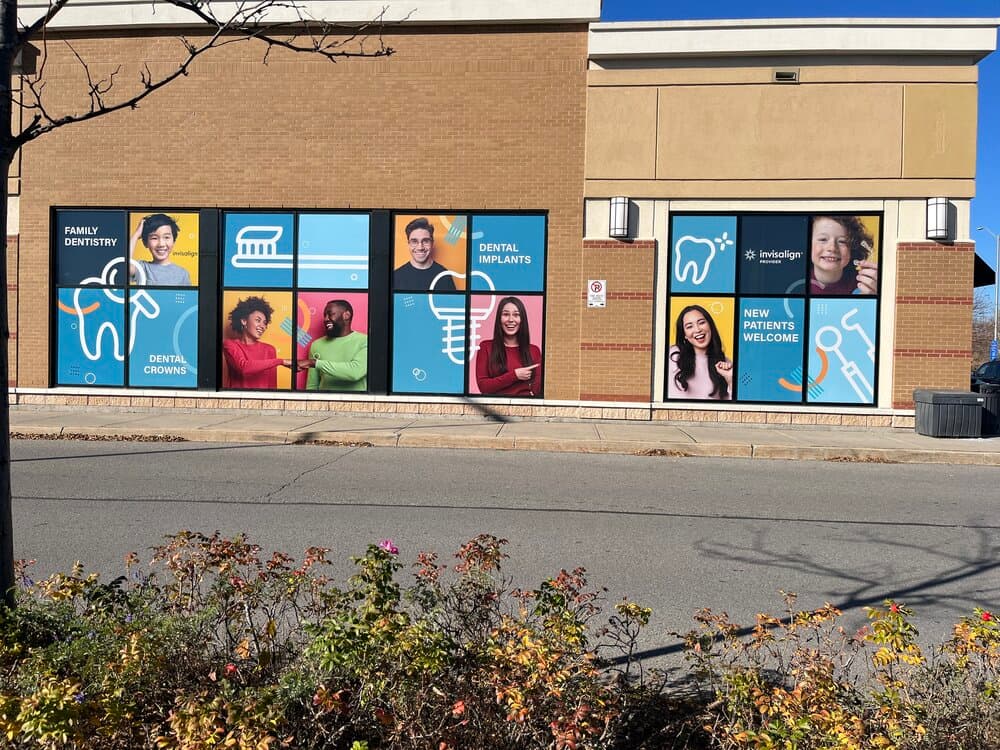
Walk through any commercial corridor in Ottawa or Gatineau and you can find two patterns of window-vinyl install. The first treats the storefront windows as one continuous billboard - hours, services, brand mark, photography, secondary copy, the whole catalogue spread across every available pane. The second treats the windows as a balance between visibility into the interior and selective brand reinforcement on the glass.
Most retail and service businesses sign off on the first pattern because the vendor mockup looks dramatic. A mockup with copy filling every window reads as comprehensive, organized and professional in the rendering. Walking up to the actual storefront after install, the same coverage reads as an obstruction. Customers cannot see what is inside the business. The window stops being a window.
The mockup is doing what mockups are designed to do: showcase the work. It is not designed to predict the entry behaviour of the customer standing in front of the storefront six months after install.
What the research actually says
Kalantari et al. 2022 is the most recent study to test the transparency variable specifically. The researchers manipulated the degree of transparency in retail window displays - from fully opaque to fully transparent, with intermediate conditions - and measured both perceived store attractiveness and approach behaviour. The finding: higher transparency increased perceived attractiveness and increased approach behaviour. The effect was consistent across the conditions tested.
The 2022 study sits inside a longer research history converging on the same principle. Sen, Block and Chandran's 2002 study in the Journal of Retailing examined the role of store window displays on consumer judgements. Oh and Petrie's 2012 work on retail window displays added further support for the principle that consumers want signal about the store interior before they decide whether to enter.
Surjit's 2021 work on theme-based window displays adds a complementary finding for the seasonal-refresh case: theme-based displays significantly outperformed non-themed ones on consumer favourability, with theme-based displays showing roughly 86.5% favourable response compared with roughly 38% for non-themed displays.
The collective principle: consumers approaching a storefront want to see inside. They make an entry decision in part on what the interior signals. Window vinyl that obscures the interior interferes with that decision. Window vinyl that preserves visibility while carrying brand and selective messaging cooperates with it.
For the broader research base on what storefront signage does for revenue, see the business case for storefront signage research summary.
When partial coverage outperforms
The practical alternatives to full-opaque coverage:
Lower-band coverage. A lower band of vinyl, typically 24 to 36 inches from the floor, carries hours, contact information, certifications and selected brand messaging. The upper two-thirds of the window remains clear. The interior is visible above the lower band, which is the height range customers naturally use to read interior signals. This is the most common partial-coverage strategy for retail and service businesses.
Top-banner coverage. A horizontal band at the top of the window carries the wordmark, primary call to action, or category identifier. The customer's eyeline below the banner stays clear. Effective for businesses where the brand mark on the fascia is supplemented by a windowed wordmark, and where the interior visibility matters.
One-way vision film. A perforated vinyl that allows visibility from one direction (typically out from inside) while presenting a printed graphic from the other direction. Useful when there is a privacy reason to obscure the interior from the outside while preserving daylight and visibility from within. Less effective at preserving the entry-behaviour signal than partial coverage.
Selective panel coverage. Specific glass panels (the one behind a treatment chair, the back-of-house door panel, the seasonal display panel) are fully covered. Other panels remain clear. The customer's eyeline catches both the brand work and a clear view of the interior. This is the strategy most often used at dental and healthcare practices, where some panels require treatment-room privacy and others should preserve a clear view of the reception area.
Etched or frosted gradient. A privacy etch or frosted gradient on selected panels preserves daylight and partial visibility while obscuring direct interior view. Useful for office and professional services where the interior is functional rather than merchandised.
Window decals and wall vinyl from Lundon Calling cover most of these treatments. The right treatment depends on what the interior actually looks like and what the business wants the entry decision to feel like.
When full coverage is the right call
The 2022 research does not say full coverage is always wrong. It says full coverage depresses entry behaviour in retail and service categories where the customer's entry decision benefits from interior visibility. There are categories where the opposite holds.
Vacant-space disguise during build-out. A commercial unit under construction or build-out benefits from full-coverage vinyl that hides the work zone and presents either a "coming soon" message or a generic property identity. The customer should not see the interior because the interior is not finished. Full coverage is doing brand-protection work.
High-privacy use cases. Medical treatment rooms facing the street, certain dental treatment rooms, mental health practitioner offices, and specific legal practice setups all benefit from full-coverage privacy. Patient privacy is the controlling variable, not entry behaviour.
Back-of-house service areas. Mechanical rooms, kitchen back-of-house, and storage areas that happen to have exterior glass benefit from full coverage. The interior should not be visible because there is nothing to see.
Pre-launch and rebrand transitions. A business closing for a rebrand benefits from full-coverage vinyl that hides the in-progress interior changes and carries a "reopening" message. Once the rebrand is complete, the coverage is removed or replaced with the permanent treatment.
The rule that emerges from the research: full coverage is correct when interior visibility would actively work against the business. Full coverage is wrong when interior visibility would help the customer decide to enter. The categories above are the cases where full coverage helps. The default for most retail and service businesses is the opposite.
The dental and healthcare special case
Dental and healthcare practices sit in a useful middle position. The reception area benefits from interior visibility. A patient considering a first appointment at a clinic wants to see that the reception is clean, modern, well-lit and welcoming. Full-opaque window vinyl that obscures the reception actively works against that signal.
Treatment rooms with exterior glass benefit from full coverage. Patient privacy in the chair is the controlling concern.
The clean answer is selective coverage. The reception panels stay partial or clear. The treatment-room panels stay full-coverage. The brand work appears across the storefront in a coordinated treatment that respects both functions.
For dental clinic signage in Ottawa, Hawkesbury, Gatineau and across our service area, the dental signage page covers what a coordinated exterior treatment looks like, including the window-graphic decision. The Floss Dental Clinique Dentaire installation at Plaza Hawkesbury - covered in the Floss Dental case study - keeps the reception line of sight clear from the parking lot while the channel-letter fascia carries the brand identification.
The seasonal refresh opportunity
Window graphics are among the few permanent-looking signage elements that can be refreshed seasonally without recapitalizing. The window vinyl install is meaningfully cheaper than a full fascia rebuild. Most operators replace window vinyl on a multi-year cycle by default, which means the same message sits on the glass through 12 to 24 months of seasonal variation.
Surjit 2021's finding on theme-based displays argues for a more active refresh cadence. Four to six refresh cycles per year on window graphics (winter, spring, summer, fall, plus one or two campaign cycles) align the window with seasonal demand drivers, holiday awareness moments, and ongoing campaigns. For dental practices, that might be Breast Cancer Awareness Month in October, oral health themes around children's back-to-school in September, holiday hours in December, and so on. For retail, it tracks the merchandising calendar more directly.
The economics are favourable. Window vinyl install at the typical retail or service unit runs in the low four figures per cycle, depending on coverage area and material. Four to six refresh cycles a year sits inside most marketing budgets that are already spending on paid digital.
What this changes for the operator
A retail or service business in Ottawa, Gatineau or Eastern Ontario sitting on full-opaque window vinyl that was installed at the original buildout and never revisited has a research-backed reason to revisit it. The intervention is not always full removal. Selective re-treatment - removing coverage from the panels that should preserve interior visibility, keeping coverage where privacy or brand-protection warrants it - typically produces the visibility lift at a fraction of full removal cost.
For most retail and service categories, the default move on a window-graphic refresh is less coverage, not more. The vendor selling the next install will not lead with that recommendation. The research supports it anyway.
About Lundon Calling
Lundon Calling is a full-service commercial signage company based in Ottawa, serving Eastern Ontario and Western Quebec. We design, fabricate, and install exterior and interior signage, including window graphics, privacy films and UV window films, for retail, service, dental and healthcare businesses across a 200 km service radius - including Kingston, Brockville, Cornwall, Smiths Falls, Pembroke, Belleville, Gatineau, and Hawkesbury.
Contact us today for a complimentary signage assessment.
(613) 854-9255 info@lundoncallinginc.com lundoncallinginc.com